
What happened in the market?
Overall the European Energy Markets feel like they want to buy bullish stories more than sell bearish ones; sentiment remains strong. The first photographic evidence (that we’ve seen) of Ukrainian gas facilities having been damaged in the war surfaced over the weekend (although little or no gas is actually flowing). Uncertainty continues about whether or not the US will impose tariffs on European goods. Then the question is how this gets digested by the markets – so far that remains somewhat unclear, common sense would suggest that it would be bearish industrial demand in Europe and therefore bearish European energy markets, however trade flows tend to adjust around tariffs pretty quickly so pricing the impact is an art rather than a science. More weather volatility as model runs continue to come in, no sign yet of a Scandinavian blocking high. Again, if model runs come in indicating cold weather, prices go up quicker than they go down in the alternative scenario.
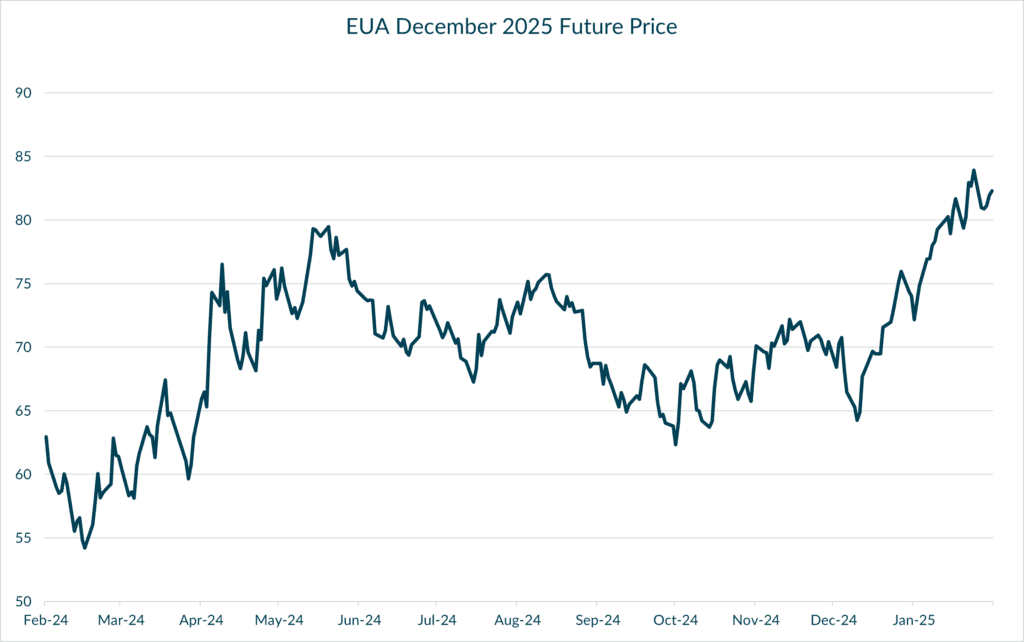
In EUAs, Monday saw a sharp sell-off in as global equity markets declined. December 2025 futures hit the week’s high at €84.22 before pulling back. On Tuesday, futures closed nearly unchanged, with strong volume and a wide trading range, reaching the week’s low at €79.48. Mid-week, prices spiked briefly following the UKA auction, which cleared at a +€2.00 premium, but later retraced. By Friday, futures traded within a much tighter range on lighter volume. The week ended at €82.28, down €1.65 from the previous week.
Source: Bloomberg
Price & position data
December 2025 Futures December 2025 Futures
Week 6 3 Months ICE position w/w Change
VWAP €81.07 €75.56 Investment Firms -315,443 -17,589
High €84.50 €84.50 Investment Funds 55,566 2,478
Low €77.90 €64.05 Commercial Undertakings 196,457 14,837
Average Daily Volume 30,861 19,106 ETS Compliance Firms 61,573 25
Source: Bloomberg Source: Bloomberg, Definitions on ICE,
Other Emissions News
European Commissioner Wopke Hoekstra announced that over 80% of companies eligible for CBAM (Carbon Border Adjustment Mechanism) payments will be exempted from its administrative requirements, as the remaining 20% account for 97% of emissions. This move aims to reduce bureaucracy and lower costs for businesses. CBAM, introduced to protect the EU from carbon-intensive imports, began reporting obligations in late 2023, with payments starting in 2026 and full tariffs by 2034. Most costs will fall on exporters from third countries like Turkey and the Western Balkans, impacting their competitiveness. The European People’s Party (EPP) has called for a two-year delay and review of CBAM and other climate policies, as many EU importers and foreign producers struggle to comply. The proposal comes amid growing pressure to ease climate regulations, especially as the U.S. shifts away from decarbonization policies. (Source: Balkan Green News)
Questions about the UK or EU ETS? Email us!
Wishing you all a good week ahead,
Grey Epoch Europe
+44 20 7072 3313
