
What happened in the market?
The European energy complex was pre-occupied with the possibility of sudden stratospheric warming (SSW) which would produce abnormally cold weather with an added probability of low wind in Europe. An extreme example of SSW in the relatively recent past was the 2018 Beast from the East. This pre-occupation underpinned last week’s rally in front month power futures, combined with already bullish sentiment surrounding natural gas futures, given continued storage draws and perceptions about supply / demand tightness in the summer. Recent weather runs suggest that probably of such a weather event have reduced somewhat, which removed some support from prices during trading so far today, although at current levels we are pricing some probably of that event still transpiring. The most one can really say about EUAs in that context is that they went along for (some of) the ride.
Last week, December 2025 EUA futures saw an increase in prices, driven by strength in power and gas markets. Intraday volatility was high throughout the week. The weekly low was recorded on Tuesday at €78.30, while Thursday saw the peak at €84.50, just a few cents above Friday’s high of €84.44. Futures rallied sharply into the auction before gradually selling off over the remainder of the day, ultimately settling lower. On Friday, futures closed the month at €83.93, marking the highest settlement of the year and a €2.29 increase from the previous week.
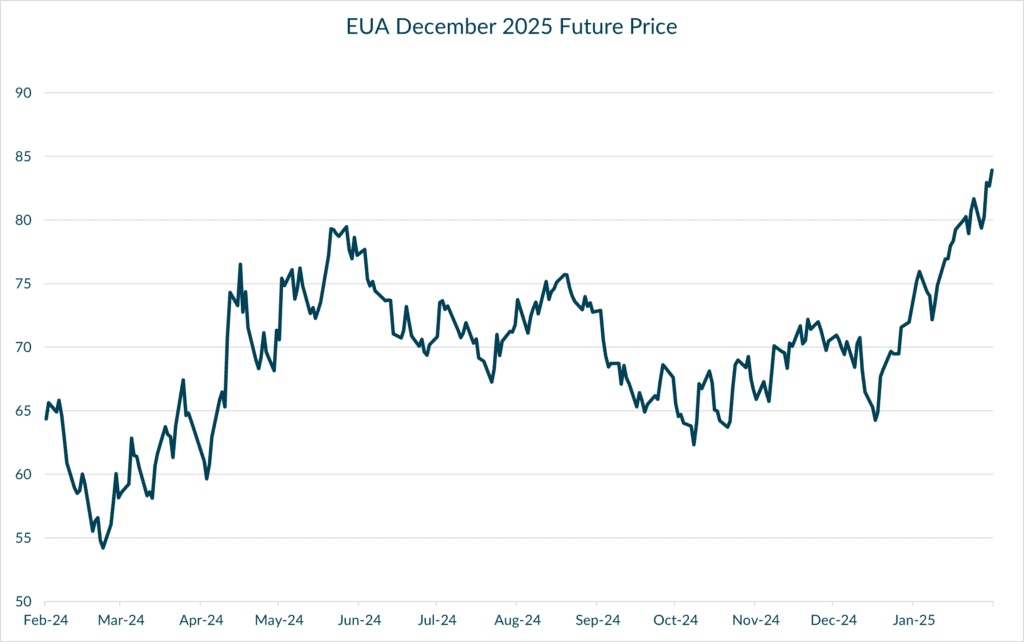
Source: Bloomberg
Price & position data
December 2025 Futures December 2025 Futures
Week 5 3 Months ICE position w/w Change
VWAP €81.66 €74.64 Investment Firms -297,896 -11,121
High €84.50 €84.50 Investment Funds 53,043 11,184
Low €78.30 €64.05 Commercial Undertakings 181,665 136
Average Daily Volume 30,147 18,149 ETS Compliance Firms 61,547 312
Source: Bloomberg Source: Bloomberg, Definitions on ICE
Other Emissions News
At the start of 2025, EU and UK carbon prices diverged due to differing market sentiments and although the gap narrowed after a UK price rally in late January, a significant difference remains. Three key EU market reviews in 2025 could tighten supply and support prices, including potential changes to the Carbon Border Adjustment Mechanism by year-end and the 2040 climate target review in February, which will impact free allocations from 2026. Meanwhile, the UK faces uncertainty with pending policy reviews and has postponed tightening free allocations to 2027 to align with its carbon border tariff. Talks of linking the EU and UK carbon markets have resurfaced, which could boost liquidity in the UK market, though such integrations are complex and time-consuming. (Source: Bloomberg)
Germany’s snap federal elections will be held on February 23, 2025, following the collapse of the traffic light coalition (SPD, Greens, and FDP) due to disagreements over budget policies during an economic crisis. The CDU/CSU currently leads in the polls and sees the EU ETS as crucial to reaching the 2045 climate neutrality goal, while SPD and the Greens support maintaining this target. Die Linke proposes accelerating this to 2040, though this conflicts with the new ETS2 covering buildings and transport from 2027. FDP advocates for delaying climate neutrality to 2050, while AfDand BSW oppose both the target and carbon pricing. Germany may need to keep coal plants available longer, leading to higher emissions and additional carbon pricing. Other European countries, including Poland, Romania, and others holding elections this year, also show signs of lower climate ambitions. (Source: Bloomberg)
Questions about the UK or EU ETS? Email us!
Wishing you all a good week ahead,
Grey Epoch Europe
+44 20 7072 3313
