
What happened in the market?
Having had a strong end to 2024, European Energy markets were mixed in the first couple weeks of 2025. A sell off in early January might simply have been a reversal of some end year exuberance we saw in December. Call it profit taking if you like.
We ended the week strongly however, and carried on in similar vein today (Monday). Starting with the weather, it’s been cold in Europe, and as a result we have drawn down natural gas stocks at a more rapid rate than the years since the Ukraine war broke out. At the moment, although fundamentals are tighter than they have bene for a while, we are not seeing a supply crunch this winter, but storage will need to be refilled, and it is during the traditional summer injection period that the supply demand balance tightens considerably. This is reflected in the summer25 / winter25 TTF spread being backwardated by several Euros – the market appears to be anticipating higher prices in the summer because of the need to fill storages (potentially underlined by regulatory compulsion to do so) and that this filling will only happen by competing for LNG with international markets.
Why do we care about this now in particular? Perhaps because of the announcement on Friday the US government that several Russian ports will be subject to sanctions. Europe still takes considerable amounts of Russian LNG, so the US sanctioning Russian ports will make it a lot harder for those molecules to continue to flow to Europe. While there will likely be a reshuffling eventually, with the sanctioned molecules going to places that don’t pay much attention, thus freeing up other molecules for Europe, this will not happen overnight, and will be costly, all lending support to prices.
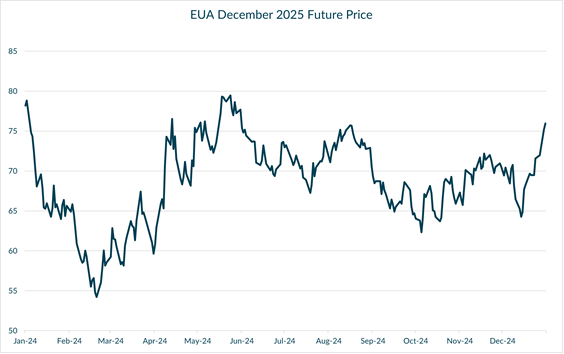
In EUAs, last week, December 2025 futures began with a high of €76.15 on Monday. By Wednesday, the market saw its third consecutive down day, accompanied by decent futures trading volumes. On Thursday, December 2025 futures opened lower but managed to recover some of Wednesday’s losses by the close. That day marked the week’s low at €71.55, resulting in a €4.60 trading range for the week. On Friday, a morning sell-off was fully reversed, with futures closing nearly €1.50 higher. December 2025 futures ultimately settled at €74.85, down €1.09 compared to the previous week.
Source: Bloomberg
Price & position data
December 2025 Futures December 2025 Futures
Week 2 3 Months ICE position w/w Change
VWAP €73.47 €70.17 Investment Firms -276,103 -289
High €76.15 €76.35 Investment Funds 19,630 15,080
Low €71.55 €63.25 Commercial Undertakings 192,115 -15,358
Average Daily Volume 26,548 12,085 ETS Compliance Firms 61,659 3,383
Source: Bloomberg Source: Bloomberg, Definitions on ICE,
Other Emissions News
• Investment funds increased their bullish bets on European Union carbon allowances to a 22-month high, according to ICE data. As of January 3, net-long positions surged to 19,628 contracts, up from 4,553 the previous week. Long positions rose by 10%, while short positions dropped by 20%. Despite a 2.7% drop in benchmark December carbon futures to €72.07 per ton on Wednesday, prices reached their highest level since June on Friday. (Source: Bloomberg)
• Germany’s Federal Environment Agency (UBA) urged that carbon pricing revenues be returned to citizens, highlighting the need for the proposed Klimageld mechanism. In 2024, Germany’s carbon pricing scheme on heating and transport fuels raised €13 billion—a 21% increase from 2023. UBA President Dirk Messner emphasized the importance of Klimageld to compensate households, especially as CO2 prices rise, and suggested combining it with targeted support for vulnerable groups. Germany’s carbon pricing, introduced in 2021, applies to fuel wholesalers and energy suppliers. The carbon price rose to €55 in 2024, up from €45 in 2023 and €30 in 2022, with a price corridor set between €55 and €65 for 2026. The revenues currently fund energy efficiency and renewable energy initiatives through the climate and transformation fund. This national scheme will be integrated into the EU-wide ETS 2 system starting in 2027. However, ETS 2’s price-dampening mechanism may not sufficiently shield households from high costs, raising concerns similar to those behind the 2018 gilets jaunes protests in France. (Source: Euractiv)
Questions about the UK or EU ETS? Email us!
Wishing you all a good week ahead,
Grey Epoch Europe
+44 20 7072 3313
